Blepharoplasty
Blepharoplasty, or eyelid surgery, is a plastic surgery procedure that removes excess eyelid skin and treats under-eye bags, to open up the gaze and reduce signs of fatigue. Unlike injectable treatments, it durably corrects skin laxity and fatty herniation, without altering the natural expression of the face. For women and men whose drooping eyelids or under-eye bags weigh down the gaze, Maison Tóā in Lausanne determines the indication after a careful examination, aiming for a natural, rested result.
-
Indications: excess skin on the upper and/or lower eyelids · under-eye bags · heavy or tired-looking eyes
-
Type of anaesthesia: local anaesthesia
-
Procedure duration: 45 to 90 min (one eyelid) · 2 h (upper + lower)
-
Hospitalisation: outpatient
-
Recovery: work 2 weeks · sport 2 weeks
- Price : See our prices
What is blepharoplasty?
Blepharoplasty is a plastic surgery procedure of the eyelid contour that treats excess skin, eyelid laxity and fatty herniation (bags). It opens up the gaze, removes bags and restores facial harmony, durably, without freezing the natural expression of the eyes.
Objective
Rejuvenate the gaze by making it more open and rested, without a “surprised” effect: the eyes look more awake, and under-eye bags are markedly reduced, even smoothed away. The procedure is measured and tailored to each patient’s anatomy.
Principle
Three approaches are possible depending on the indication: upper blepharoplasty (precise removal of skin, with resection or redistribution of fat); lower blepharoplasty (treatment of bags via a transconjunctival or direct approach); and combined blepharoplasty, which treats the upper and lower eyelids in the same operation.
Method used
For the upper eyelid, the incision is hidden in the natural crease (tarsal fold); for the lower eyelid, it is placed 2 mm from the lash line or made via a transconjunctival approach. The surgeon removes the fatty herniations and excess skin, then closes with non-absorbable sutures, fully removed after 1 week.
Differences from other approaches
Non-surgical techniques do not replace blepharoplasty in cases of excess skin or pronounced bags: hyaluronic acid injections are suited to a mild tear trough hollow, Botox can lighten a heavy-looking gaze by slightly lifting the tail of the eyebrow, and lasers or peels smooth fine lines. However, these approaches remain temporary, whereas blepharoplasty offers a lasting result.
Indications and treated areas
Blepharoplasty is aimed at women and men whose sagging eyelids or under-eye bags weigh down the gaze, after a clinical assessment of skin quality and eyebrow dynamics. Common signs: drooping eyelids, persistent bags, excess skin hindering the opening of the eyes.
Main indications
Over time, eyelid skin loses elasticity and the tissues relax, leading to excess skin, fatty bags or muscle sagging that weigh down the gaze, even in well-rested people.
Secondary indications
When excess skin on the upper eyelid hinders the opening of the eyes or the visual field, blepharoplasty also improves visual comfort. In these duly documented functional cases, coverage by basic health insurance (LAMal) may be considered, following a specialist opinion.
Treated areas
The treated areas are the upper and lower eyelids.
Specific areas
Combined surgery treats the upper and lower levels in the same operation. The eyebrow and peri-orbital region are assessed during the consultation and may call for other procedures (tensor threads, Botox, hyaluronic acid or a lift).
Limitations
Blepharoplasty does not correct pigmented (dark) circles, which call for other approaches. It can be considered from your forties onward, or earlier in case of genetic predisposition; skin ageing then continues naturally afterwards. An ophthalmological opinion is recommended in cases of dry eye, true ptosis or eyelid closure disorders.
What happens during the appointment at the Maison Tóā clinic in Lausanne?
1 The consultation

The consultation establishes the precise indication (upper, lower or combined) and assesses skin quality, the presence of bags and eyebrow dynamics. An ophthalmological opinion may be requested if necessary. The anaesthesia technique is defined together with the surgeon.
Read more2 The procedure

Performed on an outpatient basis, most often under local anaesthesia (sometimes with sedation), the procedure takes 45 minutes for the upper eyelids and around 2 hours for combined surgery. The surgeon removes the fatty herniations and excess skin through discreet incisions. The sutures are closed with non-absorbable stitches, removed after 1 week.
Read more3 The follow-up

In the first few days, irritation or dry eyes may occur, without real pain, with possible temporary watering between day 4 and day 7. It is advisable to protect the eyes from light and to sleep with the head elevated. Social downtime is 7 to 10 days.
Read moreResults: What should you expect? (Before/After)
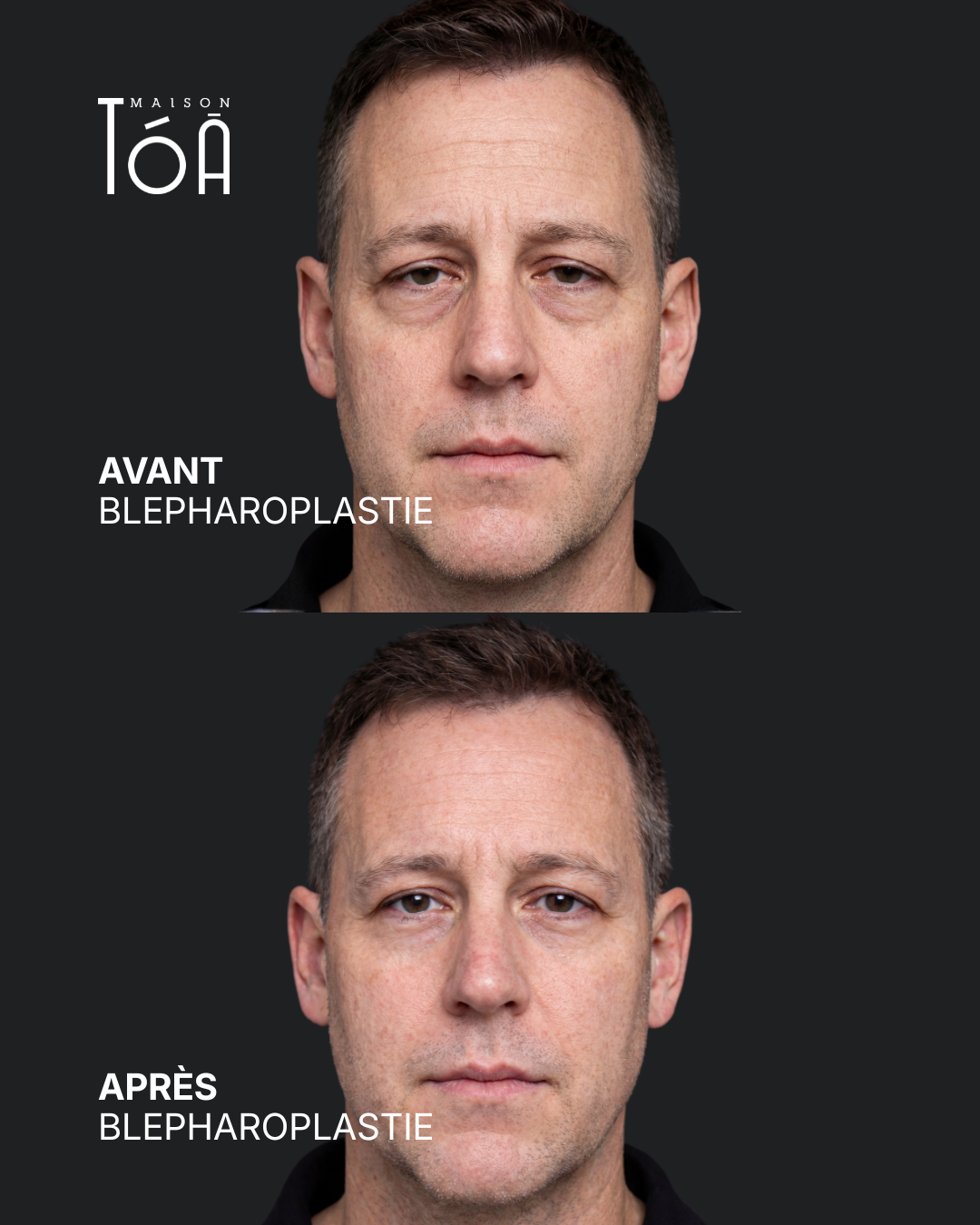
The results of blepharoplasty become clearer progressively, as the swelling subsides and the scar fades.
BEFORE / AFTER
First results
The gaze looks more open and rested from the first few weeks. Swelling and bruising are common at first and subside quickly.
Settling
The optimal result is visible around 3 months, the time needed for the tissues to regain their suppleness and for the swelling to fully subside.
Duration
The effects are long-lasting. Removal of the bags is permanent; however, new skin laxity may appear after about ten years, as natural ageing continues.
Maintenance
Blepharoplasty does not require any particular maintenance. Good sun protection during healing and eye-contour skincare help preserve skin quality.
Variability
Results vary depending on skin quality, anatomy and individual healing. As with any procedure, results can vary from person to person.
Scars
For the upper eyelid, the incision is hidden in the natural crease; for the lower eyelid, it is nearly invisible (transconjunctival approach or an incision right at the lash line). Once healing is complete, there is generally no visible trace of the incision.
Contraindications and side effects
At Maison Tóā in Lausanne, the indication is always established after a careful clinical examination, and the risks are explained during the consultation.
What are the contraindications?
Certain situations lead to postponing or adapting the procedure: active infection, coagulation disorders, severe dry eye or an unassessed ophthalmological condition, an unstabilised general illness, or unrealistic expectations. An ophthalmological opinion is requested if necessary.
Possible side effects
As with any surgery, rare risks exist: infection, delayed healing, chemosis, irritation or dry eyes, asymmetry, hypertrophic scarring and, very rarely, eyelid closure disorders (ectropion, lagophthalmos). A precise indication, a measured technique and following post-operative instructions reduce these risks.
Prices
Blepharoplasty prices
At Maison Tóā in Lausanne, blepharoplasty is offered at a transparent price:
- Upper blepharoplasty: 3’000 CHF
- Lower blepharoplasty: 5’000 CHF
- Upper + lower blepharoplasty: 7’000 CHF
- Surgical consultation: 150 CHF, deductible from the first procedure if it is booked within three months of the consultation.
Payment
Payment is made before the procedure, by card or in cash. Instalment payment options are available, subject to eligibility.
What is included
The package includes the consultation, the outpatient procedure, the anaesthesia and post-operative follow-up.
Quote
The cost depends on the type of procedure (upper, lower, combined) and the complexity of the surgery. Coverage by basic health insurance (LAMal) is only possible in rare, duly documented functional cases (visual field impairment, specialist opinion). A personalised quote is drawn up during the consultation.
A deposit of 75 CHF out of the 150 CHF consultation fee is required to confirm your appointment at the Maison Tóā Clinic. In case of cancellation at least 48 hours in advance, this deposit will be fully refunded.
Alternatives and complementary treatments
Treatment alternatives
Depending on the indication, several non-surgical alternatives exist: hyaluronic acid injections for a mild tear trough hollow, Botox for a heavy-looking gaze caused by eyebrow pull, and lasers, radiofrequency or peels to smooth fine lines. These options are temporary and do not correct excess skin or pronounced bags.
Combinations with other treatments
Blepharoplasty can be combined with quality eye-contour skincare, or with tissue repositioning using tensor threads in selected indications, for a coherent overall result. Combinations are assessed during the consultation.
Why choose blepharoplasty?
Blepharoplasty durably rejuvenates the gaze without changing its expression. It is performed by Dr Sophie Nordback, FMH plastic surgeon, in a setting combining aesthetic medicine and surgery under one roof — an advantage for combining, if needed, surgery and eye-contour treatments.
Trust our experts
At Maison Tóā, our team of specialized physicians embodies excellence and innovation in aesthetic medicine. Passionate about their craft, they put their expertise at the service of your beauty and well-being. Every treatment is performed with careful attention, using the most advanced techniques to ensure natural and personalized results.

Dr. Sophie Nordback
Dr. Alexandra Miles
Dr. Reda Bennani

Dr. Laetitia Guarino

Dr. Adnan Plakalo
Dr. Natalia Koltunova
Frequently asked questions
When can you return to work after blepharoplasty?
Two weeks off is generally enough to recover after eyelid surgery. Social downtime averages 7 to 10 days, depending on healing.
What can you expect from blepharoplasty?
The gaze looks younger, more open and rested, with a naturally awake appearance. With a lower blepharoplasty, under-eye bags are markedly reduced, even smoothed away.
Why are my eyelids drooping?
Mainly because of the natural effects of gravity and age. Genetics, smoking, weight fluctuations and sun exposure also accelerate eyelid ageing.
How long does the operation take?
An upper or lower blepharoplasty takes 45 to 90 minutes; combined surgery (upper and lower) takes around 2 hours, on an outpatient basis.
Does blepharoplasty correct dark circles?
Usually not: dark circles call for other approaches. However, hyaluronic acid filler can improve the tear trough hollow.
Is blepharoplasty reimbursed in Switzerland?
Only in rare, duly documented functional cases, when excess skin impairs the visual field: partial coverage by basic health insurance may then be considered following a specialist opinion. In other cases, the procedure remains aesthetic.
Are there alternatives to blepharoplasty?
For mild to moderate bags or hollows, hyaluronic acid may be enough; Botox can subtly rejuvenate the upper eyelids when the heaviness comes from eyebrow pull. These solutions are temporary, whereas blepharoplasty offers a lasting result.
Medical consultation and appointment booking
Blepharoplasty deserves attentive care. During the consultation, Dr Sophie Nordback assesses the dynamics of your gaze, your skin quality and the presence of bags, then designs a tailored plan, in a secure setting. A personalised quote is then provided to you.