Breast augmentation
Breast augmentation is a plastic surgery procedure that restores or increases breast volume, using silicone gel implants or autologous fat transfer (lipofilling), for a fuller, better-proportioned bust. Unlike an aesthetic medicine treatment, it provides a lasting change in volume and projection, defined according to each patient’s anatomy rather than a standard. At Maison Tóā in Lausanne, every project is built after a personalised morphological assessment, towards a natural result in keeping with the figure.
-
Indications: insufficient breast volume · loss of volume after pregnancy, breastfeeding or weight loss · asymmetry or the wish for a more harmonious shape
-
Anaesthesia: general anaesthesia
-
Duration of the procedure: approximately 1 to 2 hours depending on the technique
-
Hospital stay: outpatient (day surgery)
-
Recovery: quick; sport: after 4 to 6 weeks.
- Price: See our prices
What is breast augmentation?
Breast augmentation is a plastic surgery procedure that increases or restores breast volume by inserting a silicone gel implant or by re-injecting the patient’s own fat. It adds volume, improves projection and rebalances asymmetry, durably and in a way suited to the patient’s body shape, without compromising the natural look of the breast. The choice of method depends on body shape, available tissue, the desired volume and the medical indication.
Goal
To achieve a more balanced bust, in proportion with the figure and suited to the patient’s body shape. The desired result may be subtle, natural or more pronounced depending on expectations, but it must always remain consistent with the anatomy. The consultation is used to define the desired volume, breast shape, type of cleavage and level of projection.
How it works
The procedure increases breast volume either by inserting a silicone gel implant or by autologous fat transfer. With implants, the prosthesis is placed in a precisely prepared pocket, in front of or behind the pectoral muscle depending on the indication. With lipofilling, fat is harvested from an area of the body, purified and then re-injected into the breast — an option suited to a moderate augmentation when the patient has sufficient fat reserves.
Method
Performed using one of three approaches: breast implants, breast lipofilling, or a composite technique combining an implant with autologous fat. Implants offer a more predictable gain in volume; lipofilling gives a very natural result but a more limited augmentation; the composite technique can soften the contours of an implant or enhance the cleavage in some patients.
Differences from other approaches
Unlike aesthetic medicine treatments, breast augmentation acts directly on the volume and projection of the breast, with a lasting result. No filler injection can reproduce a gain in breast volume comparable to that of an implant or lipofilling; these approaches serve different indications and goals.
Indications and treatment areas
Breast augmentation is intended for patients who wish to improve the volume, shape or balance of their bust. It aims to harmonise the figure while respecting its proportions.
Main indications
Underdeveloped breasts, loss of breast volume, “deflated” breasts after pregnancy or breastfeeding, or the wish for a more harmonious shape.
Secondary indications
Medically, breast augmentation can address marked breast asymmetry or agenesis (a breast that is underdeveloped or absent), situations in which it aims to restore balance to the bust. In some cases, an additional correction such as a mastopexy may be needed if the breasts show significant sagging.
Treatment areas
The breasts: the implant or fat is positioned to restore volume and projection.
Specific areas
With lipofilling, harvesting fat from the donor areas (abdomen, hips, thighs or knees) also refines and sculpts the figure at the same time.
Limitations
Breast augmentation does not correct significant sagging: when the breasts droop, a mastopexy may be recommended in addition. Lipofilling does not allow a large augmentation and depends on the available fat reserves. The procedure is intended for adult patients in good health, whose breasts have reached their stable adult shape and whose expectations are realistic.
How does the procedure work at Maison Tóā, Lausanne?
Every breast augmentation project follows a structured pathway, from the first surgical consultation to post-operative follow-up.
1 The consultation

Every project begins with a personalised surgical consultation. The surgeon assesses your body shape, skin quality, breast position, medical history and expectations. Implant sizers or a 3D simulation can help visualise the desired volume, followed by a period for reflection.
Read more2 The procedure

Implant augmentation is performed under general anaesthesia and takes 1 to 2 hours on average. The surgeon places the implant in a suitable pocket, in front of or behind the pectoral muscle, through an incision usually concealed in the inframammary fold. With lipofilling, fat is harvested from a donor area, purified and then re-injected into the breast.
Read more3 Follow-up

Post-operative follow-up monitors healing, comfort and how the result develops; a support bra is worn for 4 weeks. Daily activities resume gradually, while sport, saunas, steam rooms and direct sun exposure should be avoided during healing. Breast augmentation can cause pain, tightness, swelling and bruising, which gradually subside. Scar quality varies with the technique, the skin and the healing process.
Read moreResults: what to expect (before/after)
The result of a breast augmentation develops gradually as swelling subsides and the tissues adapt to the new volume, with the final result visible at 3 months.
BEFORE / AFTER
First results
The change in volume is visible as soon as the procedure is over. The breasts may, however, look tight, high or swollen for the first few weeks: this is normal and improves gradually.
Stabilisation
After implant augmentation, the result usually stabilises at around three months, as swelling subsides and the tissues adapt. For breast lipofilling, the final result is assessed between three and six months, once the injected fat has stabilised.
Duration
Modern breast implants are not devices with a fixed lifespan: they have no expiry date and are only replaced when necessary. Regular follow-up allows their condition to be monitored over time and any replacement to be discussed if needed.
Maintenance
Breast augmentation requires no particular day-to-day maintenance. Regular medical follow-up is nevertheless recommended, in particular to monitor the condition of the implants over time.
Variability
Results vary depending on body shape, skin quality, the technique used, the volume chosen, healing and lifestyle. As with any procedure, results may vary from person to person: a medical consultation is essential to set a realistic goal.
Scars
Depending on the technique, the incision is most often placed in the inframammary fold, and sometimes around the areola (periareolar) or in the armpit (axillary). The choice depends on the anatomy, the type of implant and aesthetic preference. Scars fade gradually over the months; their quality depends on the technique, the skin and individual healing.
Contraindications and side effects
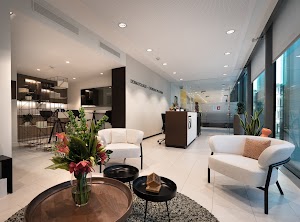
At Maison Tóā in Lausanne, every breast augmentation is considered within a rigorous medical framework. The pre-operative consultation is used to assess the indication, explain the alternatives and check that the procedure is suitable for the patient.
What are the contraindications?
A medical consultation rules out situations in which the procedure should be postponed or adapted: pregnancy or breastfeeding (procedure postponed until after this period); active infection (skin or general, to be treated before any surgery); clotting disorders (specific assessment); unstable illness (certain heart, respiratory or general conditions that may contraindicate anaesthesia); unrealistic expectations.
Possible side effects
As with any surgery, rarer complications are possible: infection, asymmetry, capsular contracture, implant rupture or rotation. These risks are explained in detail during the pre-operative consultation.
Prices
Breast augmentation prices:
At Maison Tóā in Lausanne, breast augmentation is offered at an all-inclusive, transparent price with no hidden costs:
- Augmentation with implants: from CHF 9,700
- Augmentation by lipofilling (fat transfer): from CHF 13,000
- Breast surgery consultation: CHF 200, deductible from your first procedure if it is booked at Maison Tóā Clinic in Lausanne.
Payment
Payment is made before the procedure, by means of a payment slip that we send you ahead of the operation.
What’s included
The price covers every stage of structured care: surgical consultation, pre-operative preparation, the procedure performed using the chosen technique, breast implants when this option is selected, and one year of post-operative follow-up. Anaesthesia, operating theatre and equipment costs are included.
Quote
The exact price depends on the technique chosen, the type of implants, the complexity of the procedure and the patient’s needs. A combined procedure — asymmetry correction, mastopexy or lipofilling — may be added. A personalised quote is provided after the medical consultation, specifying the cost of the procedure and what is included in your care.
A deposit of CHF 200 (the consultation fee) is required to confirm your appointment at Maison Tóā Clinic. If you cancel at least 48 hours in advance, this deposit will be refunded in full.
Alternatives and complementary treatments
Alternative treatments
Depending on the indication, several alternatives may be considered. Breast lipofilling suits patients seeking a moderate augmentation without implants. A mastopexy may be recommended when the priority is to lift the breasts rather than increase their volume.
Combining with other treatments
Breast augmentation can be performed with implants, by lipofilling or with a composite approach combining an implant and fat transfer — an option that softens the implant’s contours, improves the transition at the cleavage or refines the result. When the breasts show significant sagging, a mastopexy may be discussed in addition: it does not replace augmentation but addresses a different indication, repositioning the breasts. The strategy is always defined after a personalised medical assessment.
Why choose breast augmentation?
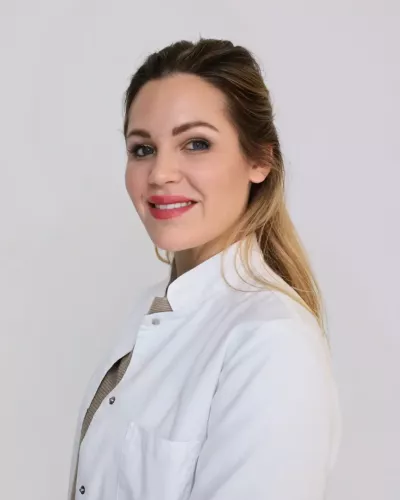
This procedure restores lost volume, improves proportions or corrects asymmetry, for a lasting, well-considered change. It is performed by Dr Sophie Nordback, an FMH-certified plastic surgeon specialising in breast surgery, in a setting that brings aesthetic medicine and aesthetic surgery together under one roof. Implants are selected according to safety and traceability criteria, and a 3D software simulation can be offered during the consultation to visualise the potential result.
Trust our experts
At Maison Tóā, our team of specialized physicians embodies excellence and innovation in aesthetic medicine. Passionate about their craft, they put their expertise at the service of your beauty and well-being. Every treatment is performed with careful attention, using the most advanced techniques to ensure natural and personalized results.

Dr. Sophie Nordback
Dr. Alexandra Miles
Dr. Reda Bennani

Dr. Laetitia Guarino

Dr. Adnan Plakalo
Dr. Natalia Koltunova
Frequently asked questions
How much does breast augmentation cost at Maison Tóā?
Breast augmentation starts at CHF 9,700 with implants and CHF 6,900 by lipofilling. The price varies with the type of implants, the technique and the complexity of the procedure. The price is all-inclusive and transparent: it covers the surgeon’s fees, anaesthesia, the operating theatre, equipment and one year of post-operative follow-up. A detailed quote is provided after the consultation.
How do I choose a breast implant?
The choice depends on the initial volume, the desired final volume and the patient’s body shape. These options are discussed with the surgeon, who recommends the most suitable implant.
Where is the breast implant placed?
Three positions are possible. In the subglandular (prepectoral) position, the implant is placed behind the gland but in front of the muscle: recovery is often quicker, but this option is less suitable for patients with little tissue. In the submuscular (retropectoral) position, the implant is placed behind the muscle, giving a more natural look in slim patients, with a recovery that is sometimes more uncomfortable. Finally, in the dual plane position, the upper part of the implant is covered by the pectoral muscle and the lower part by the breast gland. This intermediate solution is chosen during the consultation according to the patient’s needs.
How long do breast implants last?
A check-up with your surgeon is generally recommended after 10 years.
Is having implants painful?
The procedure is performed under general anaesthesia: no pain is felt during the operation. Afterwards, moderate pain and tightness are common, usually well controlled with painkillers and fading within a few days to a week. Wearing a compression bra helps limit discomfort.
Is there an alternative to implants?
Yes, lipofilling is a natural alternative for patients who prefer to avoid implants.
Where will the scars be after my breast augmentation?
Three incision sites are possible: under the breast (inframammary fold), around the areola (periareolar) or in the armpit (axillary). The choice depends on your anatomy, the type of implant and your aesthetic preference.
Can I breastfeed after breast augmentation?
In most cases, breast augmentation does not affect breastfeeding.
Related articles
Medical consultation and booking
Breast augmentation is an important decision that deserves careful support. During the consultation, Dr Sophie Nordback assesses your body shape, listens to your expectations and works with you to define the most suitable technique, in a safe setting. A personalised quote is then provided.